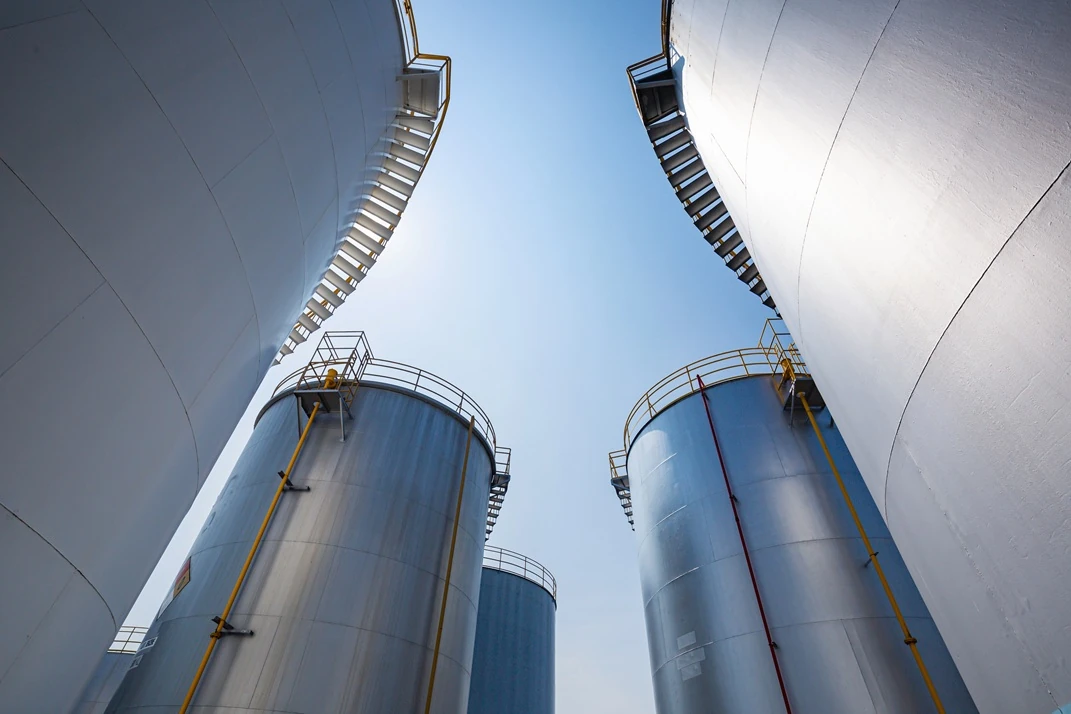
STORAGE TANK INSPECTION SERVICES
Ensure the safety and compliance of your storage tanks with our expert inspection services tailored to industry standards.
About Contact UsStorage Tank Inspection
APEC Inspection - Australia's Experts in Storage Tank Inspection Services
At APEC Inspection, we provide expert storage tank inspection services for both in-service and out-of-service bulk storage tanks. Our comprehensive inspections cover vertical and horizontal tanks, whether they are above ground or below ground.
Comprehensive Inspection Approach
Our inspection methodology combines advanced techniques to thoroughly assess the condition of tank components, including:
- Tank Floors
- Tank Shells
- Tank Roofs
- Structural Integrity
Compliance and Quality Standards
We ensure compliance with industry standards by providing detailed inspection reports that include engineering calculations according to API 653 and API 650 specifications, as well as other relevant guidelines.
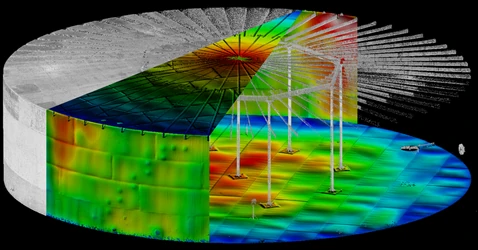
Integrating API 653 standards with 3D laser scanning for tank inspections enhances the process significantly. Here are some key benefits:
- Compliance with Standards: 3D laser scanning ensures that inspections meet API 653 standards for verticality, roundness, flatness, and subsidence measurements.
- Detailed Reporting: The technology provides comprehensive reports aligned with API 653 guidelines, including data on tank shell verticality, roundness, tank bottom flatness, and subsidence.
- Enhanced Accuracy: The precision of 3D laser scanning allows for accurate detection of out-of-tolerance areas, ensuring that any deformations or defects are identified and addressed promptly.
- Efficiency: The process is much faster than traditional methods, allowing for quicker inspections and reduced downtime.
- Safety: Reduces the need for manual inspections, minimizing the risk to personnel by limiting their time inside the tank.
Advanced Inspection Techniques
Our team utilizes a wide range of cutting-edge equipment and techniques to guarantee accurate and reliable results, such as:
- Ultrasonic Floor Scan Inspection
- Magnetic Particle Weld Inspection
- Settlement Surveys
- Dimensional Checks
- Vacuum Box Testing
- Holiday Spark Testing
- Drone Inspections
- Shell Crawler Inspections
Each of these methods contributes to a detailed and accurate report that helps us maintain the highest standards for our storage tank inspections.
Contact Us
For any inquiries or further information regarding our storage tank inspection services, please don't hesitate to reach out. We are here to assist you in ensuring the safety and compliance of your storage facilities.
Request A Quote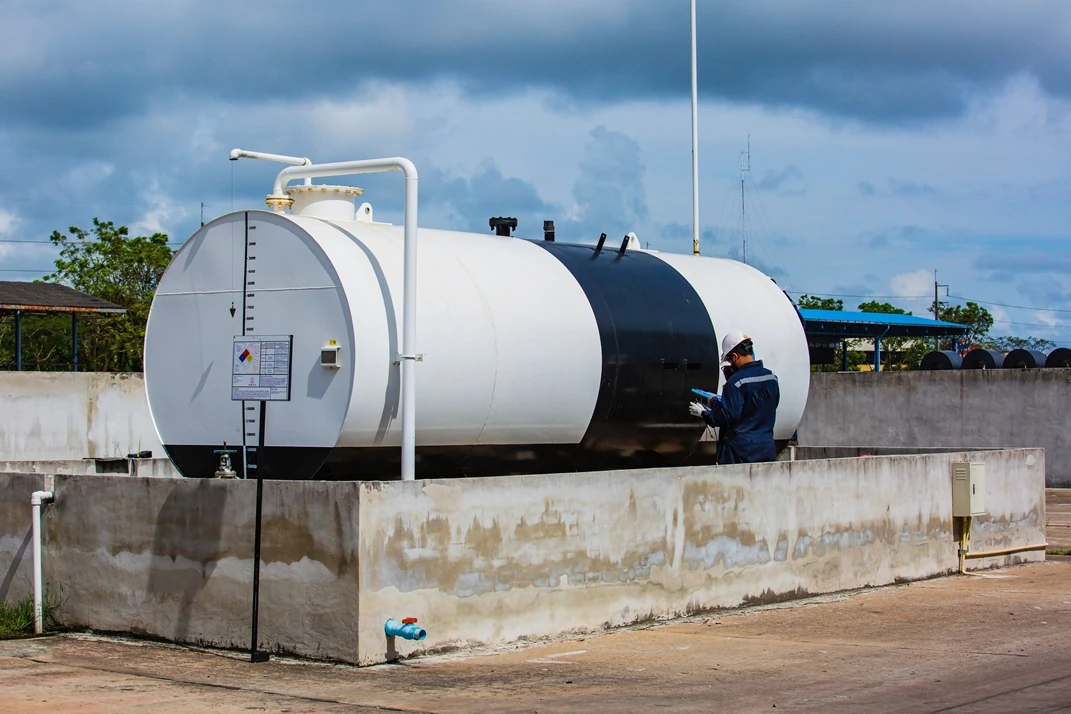
When Your Tank Needs Inspecting
API 653 sets two inspection cycles for a tank in service. The external inspection happens at least every five years, or on a risk-based interval, and can be done with the tank running. The internal inspection is the bigger job: the tank comes out of service, is emptied and cleaned, and an inspector assesses the floor, the critical zone and the lower shell. How long you can leave between internals depends on the corrosion rate measured at the last inspection, so a tank holding clean product runs longer than one in aggressive service. We help owners set those intervals from real data rather than a fixed calendar.
Inspecting the Tank Floor
Most tanks fail from the bottom up. Water and sediment settle on the floor, and underside corrosion eats the plate from below where you cannot see it. That is why the floor gets the most attention during an internal inspection. We scan it with magnetic flux leakage (MFL) to find top and underside metal loss, take ultrasonic readings to confirm remaining thickness, and vacuum box the floor welds to prove they are leak-tight. The shell is checked for thinning and out-of-roundness, and settlement is measured around the base. Read together, these tell you whether the tank is fit to keep running and for how long.
API 653, API 650 and the Australian Standards
New tanks are built and tested to a construction code, almost always API 650 or the earlier API 12C. Once a tank is in service, API 653 governs its inspection, repair and reconstruction, and any repair has to take it back to the original construction code. In Australia those API codes work alongside AS 1692, which covers the construction of steel tanks for flammable and combustible liquids, and AS 1940, which covers how those liquids are stored and handled on site. Our reports reference the codes that apply to your tank and back the findings with engineering calculations, so they hold up with auditors and insurers.
What a Tank Integrity Assessment Tells You
An inspection produces findings. A tank integrity assessment turns those findings into decisions. The measured thickness readings are compared against the minimum required thickness for the shell course and the floor, corrosion rates are calculated from the change since the last inspection, and those rates set the remaining life of the tank and the date of the next internal. Where a course has thinned below what the standard allows, the assessment sets out the options: derate the tank, repair or replace the plate, or shorten the interval and monitor. Owners use that output to plan a shutdown budget rather than react to a leak.
NDT Methods We Use on Storage Tanks
Tank work draws on most of the NDT toolkit, and the method is chosen for the component being assessed:
- Magnetic flux leakage (MFL) — floor scanning to map top-surface and underside metal loss quickly across large areas.
- Ultrasonic testing (UT) — thickness readings on the shell, floor and roof, and corrosion mapping to confirm what MFL flags.
- Magnetic particle (MT) and liquid penetrant (PT) — surface and near-surface crack detection on welds, nozzles and repair areas.
- Vacuum box testing — proving floor and annular welds are leak-tight without filling the tank.
- Coating inspection — assessing the internal lining and external protective system, including holiday detection on linings.
- Visual inspection (VT) — the foundation of every API 653 external and internal inspection.
- Positive material identification (PMI) — confirming plate and repair materials match specification.
Where access is difficult, drone inspection covers roofs and upper shell courses without scaffolding, and hydrostatic testing is used to prove integrity after significant repair work.
Tanks and Vessels We Inspect
The same inspection disciplines apply across a range of assets. We assess vertical and horizontal bulk storage tanks holding fuel, chemical and process liquids, above and below ground. We inspect water storage tanks, where the concern is usually internal lining condition and floor corrosion rather than product compatibility. We also inspect pressure-rated vessels such as air receivers, which sit under a different regime again — those are covered on our pressure vessel inspection page, and our guide to air receiver inspection services explains what AS/NZS 3788 requires of them.
What You Receive
Every inspection produces a written report you can hand to an auditor, an insurer or a regulator. It records the scope and the codes applied, the thickness data with the locations it was taken from, photographs of the findings, the calculated corrosion rates and remaining life, any non-conformances with a recommended action, and the date the next inspection falls due. Where a repair is needed we set out what the standard requires so you can scope the work accurately before going to a contractor.
Where We Inspect
APEC is based in Newcastle and works throughout the Hunter and New South Wales, mobilising inspectors to sites across Australia for tank inspection and shutdown work. Tank inspections are usually planned around a shutdown window, so we schedule the crew and equipment to the outage rather than the other way around. If you have a shutdown coming up, talk to us early — internal inspections need the tank emptied and cleaned, and that sequencing is easier to arrange with notice.
Why Choose APEC Inspection for Storage Tank Inspection
APEC is a NATA-accredited inspection body. Our storage tank work is carried out by AINDT-certified technicians, with API 653 inspections signed off by a certified tank inspector. We assess vertical and horizontal tanks, above and below ground, and bring the NDT, ultrasonic testing, drone inspection and reporting together in one job. We mobilise from Newcastle and the Hunter across the country. To book an inspection or talk through an upcoming shutdown, request a quote.
Frequently Asked Questions
- What types of storage tanks does APEC Inspection inspect? +
- We inspect in-service and out-of-service bulk storage tanks, including vertical and horizontal configurations, above and below ground.
- What standards does APEC follow for tank inspections? +
- In-service inspections follow API 653 and new tanks are assessed against their construction code, usually API 650 or the earlier API 12C. In Australia, tanks are also built to AS 1692 and operated under AS 1940 for flammable and combustible liquids.
- How often does a storage tank need to be inspected? +
- Under API 653 the external inspection runs on a cycle of no more than five years, or on a risk-based interval. The internal inspection interval is set by the measured floor corrosion rate, so a tank in clean service goes longer between internals than one handling aggressive product.
- What is the difference between an external and an internal tank inspection? +
- An external inspection checks the shell, roof, appurtenances, foundation and coatings with the tank still in service. An internal inspection takes the tank out of service and empty so the floor, the critical zone and the lower shell can be assessed, mainly to confirm the bottom is sound.
- How do you check a tank floor without cutting it open? +
- The floor is scanned with magnetic flux leakage (MFL) to map top and underside corrosion, ultrasonic readings confirm remaining thickness, and vacuum box testing checks the floor welds for leaks. None of these damage the plate.
- What Australian standards apply to storage tanks? +
- AS 1692 covers the construction of steel tanks for flammable and combustible liquids, and AS 1940 covers their storage and handling. These sit alongside the API 650 and API 653 codes used for design and in-service assessment.
- Is APEC Inspection NATA accredited for tank inspection? +
- Yes. APEC is a NATA-accredited inspection body and the NDT is carried out by AINDT-certified technicians, with API 653 inspection performed by a certified tank inspector, so the report is accepted by clients, regulators and insurers.
- What is a tank integrity assessment? +
- It is the engineering step that follows the inspection. Measured thickness readings are compared against the minimum required thickness, corrosion rates are calculated from the change since the last inspection, and those rates set the remaining life of the tank and the date of the next internal inspection.
- Do you inspect water tanks and air receivers as well as fuel tanks? +
- Yes. We inspect water storage tanks, where lining condition and floor corrosion are usually the main concerns, and pressure-rated vessels such as air receivers, which are assessed under AS/NZS 3788 rather than API 653.
- Where does APEC carry out tank inspections? +
- We are based in Newcastle and work throughout the Hunter and New South Wales, mobilising inspectors to sites across Australia. Tank inspections are usually scheduled around a planned shutdown window.
If You Have Any Query, Feel Free To Contact Us
Whether you'd like a fast quote, have a technical question, or want to schedule a storage tank inspection, the APEC team is ready to help.







Learn more about non-destructive testing and asset integrity.
© apecinspect.com.au. All Rights Reserved. Designed by Peritus Digital. Powered by LYFE AI